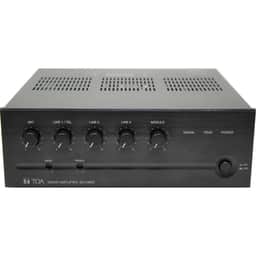
The TOA BG-2240D-AM is a five-input mixer-amplifier built around three clearly stated system parameters: 240 W output at 70 V, Class D power, and an option module slot. It brings input mixing and amplification together under one model number, making it straightforward to evaluate against a defined audio-system brief. The available source data does not identify connector types, signal formats, dimensions, included accessories, or compatible option modules, so this description focuses on the product’s confirmed capabilities.
Ideal Use Cases
The BG-2240D-AM is suited to projects whose design specifically calls for a 70 V amplifier, five inputs, and up to 240 W of stated output. It can be considered when multiple sources must feed one mixer-amplifier and when the system specification calls for a Class D power stage. The option module slot also makes this model relevant to designs that reserve a module position for an additional function. Because the module itself and its compatibility requirements are not identified in the supplied data, that part of the system should be selected separately and verified before ordering.
Why Choose This Model
Choose this model when its four defining attributes align precisely with the project: five inputs, 240 W at 70 V, Class D amplification, and an option module slot. Those details give designers and buyers a concise basis for model comparison without relying on unverified performance language. The combined mixer-amplifier format places source handling and system amplification in the same product category, while the published 70 V rating clearly identifies the stated output configuration. The module slot provides a provision for an option module, but no particular module, function, or included expansion is specified by the source data.
Installation and Integration
Integration should begin with the 70 V system design. Compare the amplifier’s stated 240 W rating with the calculated loudspeaker load and the design margin required by the project. Map the five available inputs to the planned audio sources, then confirm that the source types and physical connectors are compatible, as those details are not listed. If an option module is part of the design, verify the exact module model and supported function before installation. Mounting method, chassis dimensions, weight, mains-voltage requirements, power consumption, wiring terminals, and operating limits are also unspecified and should be confirmed in the applicable product documentation before the unit is placed into service.
Performance Highlights
The confirmed performance statement is direct: 240 W at 70 V from a Class D mixer-amplifier. This rating provides the key output figure for system-level planning, while the five-input architecture defines the stated mixing capacity. The supplied data does not provide frequency response, distortion, signal-to-noise ratio, input-specific details, or alternate output ratings. Accordingly, the 240 W figure should be treated specifically as the stated 70 V rating. Class D identifies the power-amplifier topology, but no additional efficiency, thermal, or acoustic-performance claim is made here.
What Makes It Different
The BG-2240D-AM is distinguished by the exact combination presented in its product title rather than by unlisted features. Buyers can evaluate it against five practical checkpoints: whether the system needs five inputs, whether it uses a 70 V configuration, whether the stated 240 W output is appropriate for the calculated load, whether Class D power is required, and whether the option module slot aligns with the planned configuration. The slot establishes that the model has a position for an option module, while the purpose and specifications of that module remain dependent on a compatible selection. No specific network, wireless, USB, HDMI, audio-processing, or control capabilities are identified in the supplied information.
Final Assessment
The TOA BG-2240D-AM presents a focused specification for system plans requiring five-input mixing, Class D amplification, 240 W output at 70 V, and an option module slot. Its core selection criteria are clear, but successful specification still depends on confirming the omitted connection, installation, electrical, and module-compatibility details. It is best evaluated as a purpose-defined mixer-amplifier for projects that match its explicitly stated input count, output rating, voltage configuration, amplifier class, and expansion-slot requirement.